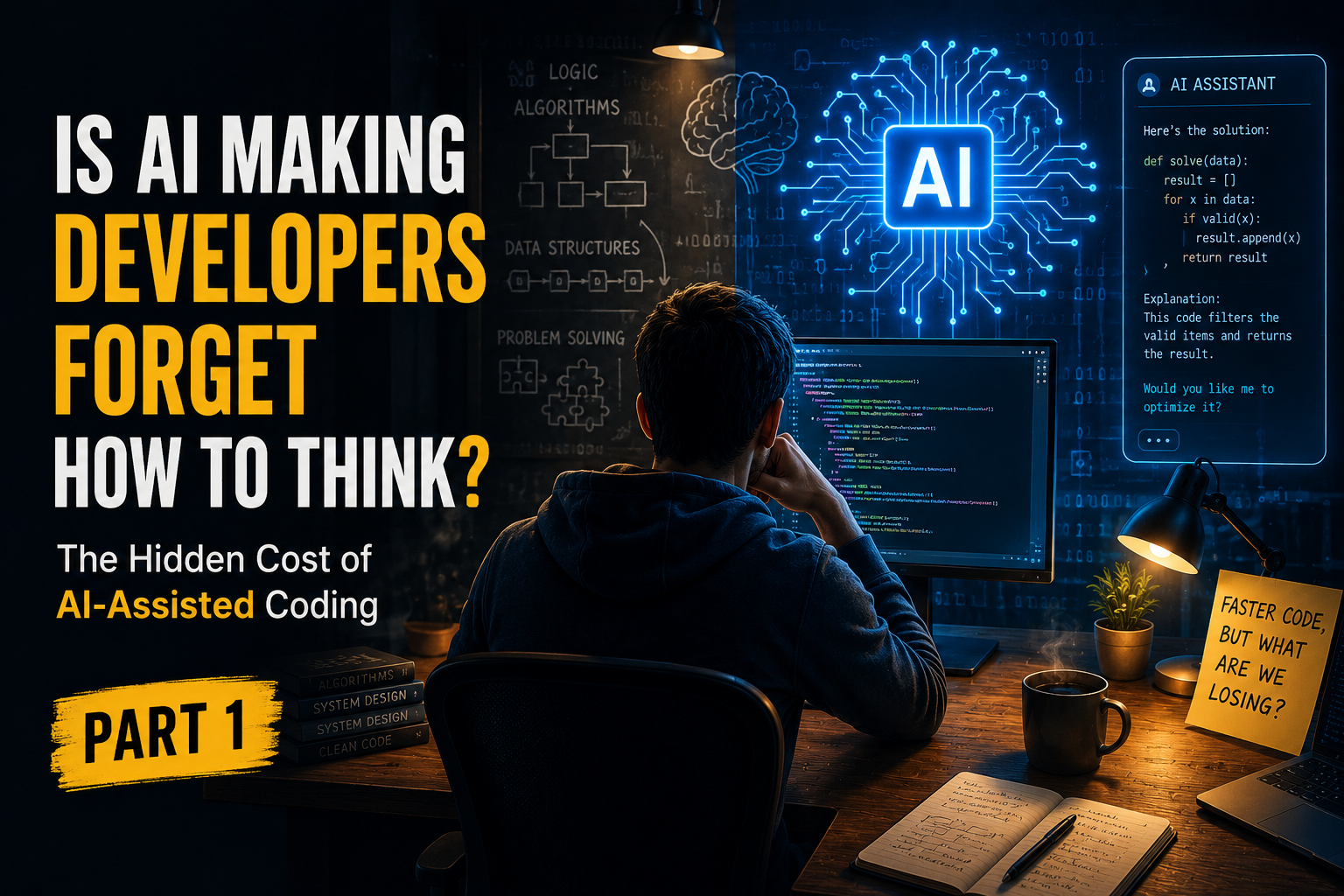
When "It Works" Isn't Good Enough
One of the most common phrases you'll hear in software development is:
"It works on my machine."
With AI, that phrase has evolved into something even more concerning:
"ChatGPT said this should work."
The problem isn't that AI is wrong all the time. In fact, it's surprisingly accurate for many day-to-day programming tasks.
The real issue is that developers sometimes stop asking why the solution works.
If AI suggests changing a database query, adding a middleware, or updating a dependency, it's tempting to trust it—especially when you're under pressure to deliver.
But software doesn't exist in isolation.
Every change affects performance, security, scalability, and maintainability.
A solution that fixes today's bug could introduce tomorrow's production incident.
That's why experienced developers don't just review code. They review the reasoning behind the code.
The Rise of "Vibe Coding"
There's a new term that's been making the rounds in developer communities: vibe coding.
It describes a style of development where the focus is on quickly building features by describing what you want and letting AI generate the implementation.
Need a dashboard?
Prompt AI.
Need authentication?
Prompt AI.
Need a payment integration?
Prompt AI.
Need tests?
Prompt AI.
There's nothing inherently wrong with this approach. In fact, for prototypes, internal tools, hackathons, or personal projects, it can be incredibly effective.
The danger comes when vibe coding becomes the default way of building production software.
Software isn't just about making features work.
It's about making them reliable, secure, maintainable, and understandable by the next developer who opens the project six months later.
Speed is valuable.
Understanding is essential.
The best developers know the difference.
Senior Developers Aren't Faster Because They Type Faster
One misconception AI has reinforced is that programming is mostly about writing code.
It isn't.
Ask any senior engineer where they spend most of their time.
The answer usually isn't typing.
It's thinking.
They spend time understanding business requirements.
Reviewing architecture.
Identifying edge cases.
Planning how different systems interact.
Considering performance.
Evaluating security implications.
When they finally start writing code, the implementation often comes together quickly—not because they're fast typists, but because they've already solved the problem in their mind.
AI can help generate code.
It can't replace years of engineering judgment built from production failures, difficult debugging sessions, and hard-earned experience.
The Skills That AI Can't Learn From Your Codebase
AI is trained on enormous amounts of public knowledge.
But your company's software isn't just code.
It contains years of business decisions.
Why is a particular validation rule there?
Why does one customer have a special workflow?
Why was a service intentionally designed in a certain way?
Those answers rarely exist in documentation.
They exist in conversations, meetings, customer feedback, and engineering decisions made over time.
That's why software engineering is about much more than syntax.
Great developers understand context.
And context is something AI still struggles to infer consistently.
AI Is Changing What Companies Look For
A few years ago, companies often looked for developers who could quickly write algorithms during interviews.
Today, many organizations know AI can generate a solution to most coding problems within seconds.
That changes the value of certain skills.
Increasingly, companies are asking different questions:
Can you design a scalable system?
Can you explain why one solution is better than another?
Can you identify security risks?
Can you review AI-generated code critically?
Can you communicate technical decisions clearly?
In other words, the ability to think is becoming more valuable than the ability to remember syntax.
Ironically, AI may increase the demand for strong engineering fundamentals rather than reduce it.
Using AI Without Losing Your Programming Skills
The goal isn't to stop using AI.
That would be like refusing to use version control because developers once managed files manually.
The smarter approach is to change how we use it.
Here are a few habits that make a big difference:
Solve the problem before asking AI
Spend a few minutes thinking through the issue yourself.
Even if you don't solve it completely, you'll understand the AI's response much better.
Read every line of generated code
Treat AI-generated code the same way you'd review a pull request from another developer.
Don't assume it's correct just because it compiles.
Ask AI to explain, not just generate
Instead of saying:
"Write authentication."
Try asking:
"Explain why this authentication flow uses middleware instead of route guards."
The second question teaches you something.
Verify everything
AI can make subtle mistakes.
Wrong assumptions.
Deprecated APIs.
Security issues.
Performance bottlenecks.
Blind trust is never a good engineering practice.
The Developers Who Will Thrive in the AI Era
Every major technological shift changes what it means to be valuable.
When cloud computing became mainstream, infrastructure engineers adapted.
When DevOps emerged, developers learned deployment pipelines.
When containers became common, teams embraced Docker and Kubernetes.
AI is simply the next evolution.
The developers who succeed won't necessarily be the ones who write the most code.
They'll be the ones who understand systems, solve problems, communicate effectively, and use AI as a force multiplier instead of a crutch.
Being able to generate code quickly is useful.
Being able to make the right engineering decision is far more valuable.
Final Thoughts
AI has changed software development forever.
That's no longer a prediction—it's our daily reality.
It helps us build faster.
It reduces repetitive work.
It makes learning new technologies easier.
It allows small teams to accomplish what once required much larger engineering groups.
Those are incredible advantages.
But every powerful tool changes the habits of the people who use it.
The question isn't whether AI is making developers forget programming.
The better question is whether we're still investing time to understand the code we ship.
Programming has never been about memorizing syntax.
It's about curiosity.
Problem-solving.
Critical thinking.
And making decisions when there isn't an obvious answer.
AI can help with many of those tasks.
It cannot replace the mindset that turns a programmer into an engineer.
As developers, our greatest strength has never been how fast we type.
It's how deeply we think.
And that's one skill no prompt should ever replace.
Key Takeaways
- AI has made developers significantly more productive, but productivity shouldn't come at the cost of understanding.
- Copying AI-generated code without reviewing it can create long-term maintenance and security issues.
- Problem-solving, debugging, and architectural thinking remain essential software engineering skills.
- Junior developers should use AI as a learning companion, not as a shortcut around programming fundamentals.
- The future belongs to developers who combine strong engineering knowledge with intelligent use of AI.

No comments yet
Be the first to start the discussion!